We have harvested from the water, but it looks like we should be harvesting from Mom's garden as well! Have we already begun drying Hibiscus flowers? http://www.nytimes.com/
2005/07/20/dining/20soda.html?
Recipe: Sorrel Punch
Time: 10 minutes, plus at least 4 hours' steeping
1½ cups dried sorrel (hibiscus) flowers, available at Caribbean grocers
¼ cup coarsely chopped ginger
1 cup sugar
Lime wedges for garnish.
1. Boil 6 cups water. Pick over sorrel, discarding discolored pieces. Combine sorrel and ginger in a large bowl and cover with boiling water. Let mixture steep for at least 4 hours or overnight.
2. Meanwhile, in a small saucepan, combine 1 cup water and sugar; boil. Reduce heat to medium and stir until sugar is dissolved. Set aside to cool.
3. Strain sorrel mixture into a jar, add sugar water and taste. Punch should be slightly tart.
4. Chill punch and serve over ice, garnished with lime wedges. For a spritzer, fill a glass 1/3 full with punch and top off with sparkling water. Punch may also be mixed with rum and lime for a cocktail.
Yield: About 6 cups.
Recipe: Ginger Beer
Time: 10 minutes, plus at least 4 hours' steeping
12 ounces ginger, washed and roughly chopped (about 2 cups); peel if you want a lighter-colored beverage
1 bay leaf
¾ cup sugar
Juice of 1 lemon.
1. Place chopped ginger in a large bowl. Add bay leaf. Boil 10 cups water and pour it over ginger. Let mixture sit for at least 4 hours or overnight.
2. Meanwhile, in a small saucepan, place ¾ cup water and the sugar and bring to a boil. Reduce heat to medium and simmer just until sugar has melted, stirring occasionally. Set aside to cool.
3. Strain ginger mixture into a pitcher or a glass jar, mix in sugar water and lemon juice. Stir and serve over ice.
Yield: About 10 cups.
Pyongyang Noodles - North Korea
There is a NY Times Editorial/Op-Ed video featuring Pyongyang noodles in North Korea out today. They look like a brown/purple vermicelli, are served cold in a clear broth, include toppings (similar to Japanese ramen: ex-post), and are condimented with a splash of vinegar (like my local greens!) and soy sauce. Definitely more delicate than I would expect from NK.

Whole Baked Grouper
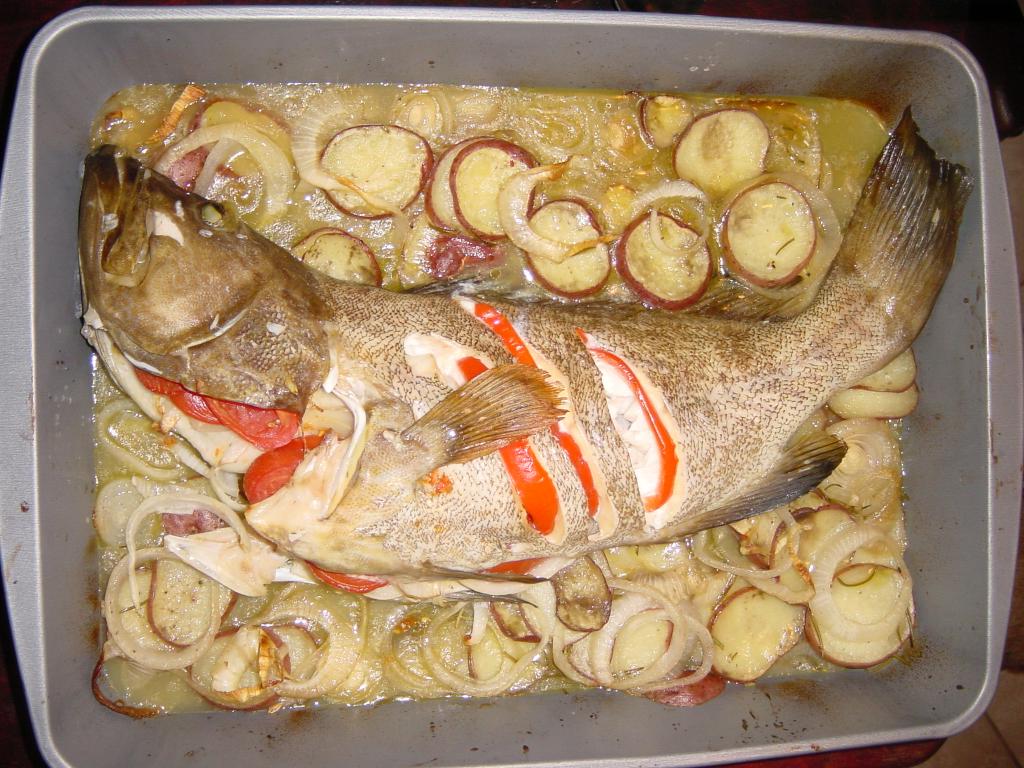
Using another age proven recipe, my mother stuffed this grouper with tomatoes and onions and baked it. This fish was perfect for its size and feast potential, but I am not sure the baking brought the best out of the species. We traditionally prepare the dish with a very lean fish, usually from the snapper family (mangrove, dog, mutton, etc.), and it is always a celebration (at least for the fishermen), because big snappers are trophy fish. This recipe preserves all the juices of the meat, and really allows you to experience the full depth these fish have to offer. Grouper is fatty and flavorful, and I think that sort of flavor conservation is not required, and actually pushes towards excessive concentration. In general, I think a good rule would be to cook snapper as if it was chicken, grouper as if it was pork.
Toronto Food Site
Even though I have not yet made my way through this entire site, each time I return, I am impressed. Great food site. http://gremolata.com/ Anyone ever try gremolata?
Gelato
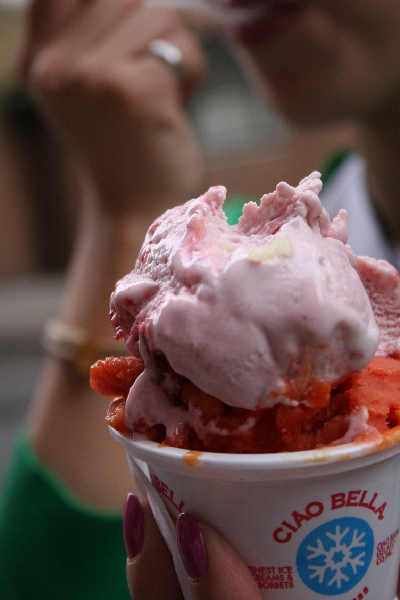
Thank god for the gelato trend. I had the chance to try avocado and cranberry in Toronto yesterday, and am really happy about where this is going (prevalent, evolving, etc.). Miami has a number of Italian branded places, but the real surprise is places like Dulcianna on Lincoln Road (South Beach) that is a straight Argentine franchise. No big deal in Miami, but to find Dolcezza in Georgetown (Wisconsin Ave), an Argentine family-owned shop, makes it clear that the entire US is benefitting from Latin America's instabilities.
Sweet Toronto Dim Sum
Dim Sum is a gift. I was in Toronto all weekend, and had the chance to get a chowhound recommendation for Bright Pearl Seafood Restaurant 346-348 Spadina Ave. The food was divine, the selection extraordinary. I definitely recommend weekday Dim Sum. Anyone have any favorite dishes? Where is the best Dim Sum in NY? Any recommendations for how to recover (enough to go back to work) after one of these meals?
Murray's Farm
Drove three hours out to Tamaqua, PA to visit Koch's Farm. This family farm produces all of Murray's turkeys. It's surrounded by hills and silos with no cell phone service and not surprisingly, I had pull into another farm to ask for Koch's farm. Directions include a bit of the over the river, through the woods to Grandmother's house. Mr. Koch had us over for lunch with ginger teriyaki turkey, smoked turkey, spicy Korean turkey(kimchi turkey?!), and turkey on white heroes. Seven years ago, he went natural after almost going bankrupt like many family farms who raise commodity birds that couldn't make a sustainable living. The tilting mechanical trays of eggs mimic the hen (moms) who would ordinarily rotate the eggs in the nest. I forgot to ask about turkey eggs? Can you eat turkey eggs? Hmm. The little things get debeaked (burnt off) and it falls off after one week's time. The large toms and hens live freely outside in a large pen. The space the turkeys get are more than commodity birds which helps in the loading and slaughtering since they are more at ease with the world. Good metaphor for humans as well. I wonder what will happen to the next generation of farmers? Who will inherit the raising of animals and care of US agriculture? How many 20-40 year olds view farming as a "good career"? Will all this go to the big multinationals of the world?
Sansho - Investigatory
Have any of you had any success extending sansho from the unagi ideal? I came across a fantastic spice shop (also have a great shichimi togarashi, apparently also known as nanairo togarashi in Tokyo, but I have never heard it referred to as such) near Kiyomizudera in Kyoto, and have been trying to figure out how I can use sansho ever since. As of now, I know it doesn’t make an especially good tea (even though it is the substance behind one of the funniest phone calls I have ever received – Simon, please explain!), but I have had some success with tomatoes, both cooked and raw. I assumed this might extend its application to foods of similar acidity, but then I read in a spice guide at Amy’s house that the key to sansho was fatty foods. As all of you know, olive oil is a necessity for me, and it might have actually been the oil that the sansho had complemented so well on my tomatoes. Do any of you use it in your cooking? Should we stick to using it as a table condiment (after all the cooking is done)? I am really excited to use it on some grilled fatty fish (salmon, grouper, etc.) especially my favorite, grilled (chicharroned) grouper head (shioyaki – with only salt). Hopefully we can spear a few this 4th of July weekend in Sugarloaf.
Sansho Questions:
Where is it used besides with unagi?
Does it complement tomatoes?
Does it complement olive oils?
Have any of you used it on fatty foods? fish? beef? pork?
Can we cook with it, or should it be used as a table condiment?
Sansho Questions:
Where is it used besides with unagi?
Does it complement tomatoes?
Does it complement olive oils?
Have any of you used it on fatty foods? fish? beef? pork?
Can we cook with it, or should it be used as a table condiment?

Food Romp III Jackson Heights
Food Romp I, 2003 - Manhattan. Food Romp II, 2004 - Flushing, Queens. Food Romp III, 2005 - Jackson Heights, Queens
My cousin, Ambrose's high school friend, Corey and I have organized a food romp (tour of sorts) that started organically three years ago after our professed love of eating all foods. Corey does all the work which include a well plotted walking map (and I throw in a few comments) two months prior. Thus, starting an annual tradition that has grown in number each year. A few weeks ago, we hosted a group of 15 or so avid eaters who were brave enough to go Jackson Heights from the likes of New Haven to Manhattan in order to visit the vibrant, bustling neighborhood loaded with all sorts of goodies - the Indian market(s) to Spanish grocer, who stayed open late to pour a bottle of wine on the house for us.
We kicked off the day with 11am Indian, Indian vegetarian, followed by the Kebab King, then Peruvian, Argentian, Tibetan, etcetera and in-between a sidewalk devouring of tres leches cake (see below). The day ended with some sangria and ceviche towards 3pm to stave off the sugar. Thank you, Corey.
My cousin, Ambrose's high school friend, Corey and I have organized a food romp (tour of sorts) that started organically three years ago after our professed love of eating all foods. Corey does all the work which include a well plotted walking map (and I throw in a few comments) two months prior. Thus, starting an annual tradition that has grown in number each year. A few weeks ago, we hosted a group of 15 or so avid eaters who were brave enough to go Jackson Heights from the likes of New Haven to Manhattan in order to visit the vibrant, bustling neighborhood loaded with all sorts of goodies - the Indian market(s) to Spanish grocer, who stayed open late to pour a bottle of wine on the house for us.
We kicked off the day with 11am Indian, Indian vegetarian, followed by the Kebab King, then Peruvian, Argentian, Tibetan, etcetera and in-between a sidewalk devouring of tres leches cake (see below). The day ended with some sangria and ceviche towards 3pm to stave off the sugar. Thank you, Corey.

Bell and Evans Farm
Went to visit Bell and Evans Farm, in Fredericksburg, Pennsylvania, last Thursday. It's the largest all-natural poultry company in the US and they are proud to say they are now the largest buying of certain commodities like grain feed in Pennsylvania and employ, what seems like, most of the surrounding area. I'm sure we've all seen the logo of the farm and chicken in the foreground surrounded by blue scrolls at your local Publix all the way to the South. It's about a two and a half hour drive from the city (Manhattan, that is, for all you globetrotters) and about an hour into the drive the road opens up towards Allentown onto green pastures with farms and silos just like one of the wall calendars at Barnes and Nobles.
Last year, I toured the plant where flags of Fredericksburg greeted us flying high on poles with chicken images. And this year, even prouder still, Bell and Evans' few thousand employees work on a new "air chilled" system (only one of two in the country, like Europe where most chickens are air chilled to bring down the temperature by air to 38F instead of with cold water bath aka "fecal bath"). Some employees are cut offal out of chickens all day that fly on plastic green hooks like a roller coaster up and down the ceilings, the sides, and passageways of the many rooms. The evisceration room is called "evis" and the employees work hard on the line at various stages of processing from portioning out breasts, picking Grades A-D of birds to trimming birds.
I am wearing my blue lab coat with the chicken logo on the back with the hairnet having been dripped on with chicken juice and water. I shut my eyes and smell chicken feathers. It's all very well done and we celebrate at the end with a prideful show of chicken: chicken cordon bleu, chicken nuggets, chicken parmiggiana, and grilled chicken for lunch. Another long day at the farm. Real work for real people.
Last year, I toured the plant where flags of Fredericksburg greeted us flying high on poles with chicken images. And this year, even prouder still, Bell and Evans' few thousand employees work on a new "air chilled" system (only one of two in the country, like Europe where most chickens are air chilled to bring down the temperature by air to 38F instead of with cold water bath aka "fecal bath"). Some employees are cut offal out of chickens all day that fly on plastic green hooks like a roller coaster up and down the ceilings, the sides, and passageways of the many rooms. The evisceration room is called "evis" and the employees work hard on the line at various stages of processing from portioning out breasts, picking Grades A-D of birds to trimming birds.
I am wearing my blue lab coat with the chicken logo on the back with the hairnet having been dripped on with chicken juice and water. I shut my eyes and smell chicken feathers. It's all very well done and we celebrate at the end with a prideful show of chicken: chicken cordon bleu, chicken nuggets, chicken parmiggiana, and grilled chicken for lunch. Another long day at the farm. Real work for real people.
Japanese and Korean Cookie/Cracker
I am obsessed with two brands of sweet salty cookie/crackers for pate, cheese, etc.. The first is Korean, labeled Korean Cookies on the American nutritional import label, exceptionally packaged (original Art work, never crumble, etc.) and I have had friends eating them like hosts. The second is Japanese, Harvest Sesame, and equally divine. I consider both some of the best products I have found in a long time, and would strongly recommend them not only for their quality, but also for their superior flavor. Has anyone seen/tried them as well?
Note: I have stopped purchasing my perennial favorite, Bremner Wafers, because of this solid Asian market find.
Note: I have stopped purchasing my perennial favorite, Bremner Wafers, because of this solid Asian market find.
Pate - Venison, Pork, etc.
Living in Tennessee, I am fortunate enough to not only have tons of friends who hunt, but no one to compete with when I ask for the deer hearts and livers (even the meat is considered second rate). One of these friends, Allen Mann, is consistently successful, and is the source of all of this year's meat. During the fall, I was lucky enough to receive a few livers from him (he killed a good number of deer, but these were the only ones that made it without being tainted by stomach acids or excrement, being blown to bits, etc.).
Since I had never made venison pate, I decided on a simple method: boil the liver with wine and a spice, cuisinart, add enough butter to complement, then salt and pepper to taste. I chose 4 combinations, red wine + star anise, red wine + tarragon, white wine + star anise, and white wine + tarragon. My first surprise was that venison liver tastes nearly identical to pork liver (of lechon asado fame - side note - how does ankimo taste like liver?!?). I had settled on my method while investigating with pork liver, but continue to be amazed as to how butter balances liver. Adding local butter spoonful by spoonful, pushing the cuisinart button, and tasting, the successive combinations went: liver, liver, liver, liver, absolutely divine. Making fresh alioli told me to stop right then, and to marvel at how the butter had retained the full taste of liver, but had somehow made it approachable! I felt the same way I had when I saw my first garlic olive oil combination thicken! It was fantastic.
The undisputed winner was the red wine star anise combination (admittedly, it was winter/fall), but I bet a white wine + star anise + white pepper combination would work this summer with your favorite liver!
Since I had never made venison pate, I decided on a simple method: boil the liver with wine and a spice, cuisinart, add enough butter to complement, then salt and pepper to taste. I chose 4 combinations, red wine + star anise, red wine + tarragon, white wine + star anise, and white wine + tarragon. My first surprise was that venison liver tastes nearly identical to pork liver (of lechon asado fame - side note - how does ankimo taste like liver?!?). I had settled on my method while investigating with pork liver, but continue to be amazed as to how butter balances liver. Adding local butter spoonful by spoonful, pushing the cuisinart button, and tasting, the successive combinations went: liver, liver, liver, liver, absolutely divine. Making fresh alioli told me to stop right then, and to marvel at how the butter had retained the full taste of liver, but had somehow made it approachable! I felt the same way I had when I saw my first garlic olive oil combination thicken! It was fantastic.
The undisputed winner was the red wine star anise combination (admittedly, it was winter/fall), but I bet a white wine + star anise + white pepper combination would work this summer with your favorite liver!
Ripe Pate
I have no problems eating logs of pate on my own. Today I enjoyed a Mousse Truffee from Trois Petits Cochons, the nation's leading (can also be found in Tennessee) pate manufacturer from New York. My favorite from three little pigs, it is a mixture of chicken and pork livers combined with truffles, and I love it ripe. It took a summer plane trip from Annapolis and the temptations of a melted nose to try it for the first time, but not only does pate ripen, it should be allowed to, even if a spoon becomes your only option. Don't be afraid to enjoy this one during the summer (it ripens more quickly), it is surprisingly light, and should accompany those hot afternoon riesling binges.

Brododaktylic Rice Paper.
Rice paper is different in Vietnam. Being there for a total of about 2 days, I only had the occasion to eat Spring Rolls once, but its delicately textured translucent skin was an altogether fishscale-popping-from-my-eyes experience, much like if you've only had Sushi in Kentucky and then you come to Japan and have it . And I wasn't even convinced by the stuffing. The shrimp was mid-size, slightly overcooked and limp. The scallions too tough and fragrant, the vermicelli too much... The mint was good, but yeah that's a no-brainer.
...Not that i haven't had spring rolls before... Sergio and I used to live across the Vietnam house back in our blithe university days, where we would chow down some vermicelli topped with roasted pork and fried chives seasoned with tangy nuoc cham which was yummy if you were a hunger-ravaged student after three hours of Physics lab trying to fit a regression-curve onto datapoints resembling my three-year old cousin's confetti opus, and you only had about $1.43 (in change) chinkling around in your unwashed jean pockets.
This rice paper in Saigon was different, taking the eating experience of the spring rollto an almost an entirely different dimension. Most rice paper sold outside Vietnam comes as hard, dry white sheets that you then wet with a little water to soften and wrap. The rice paper in Vietnam (or the fresh ones at least) go through this process of double-heating that separates the inner and outer skin (giving it a more delicate crepe-like texture), and then are dried on woven bamboo baskets (which give the rice paper their cross-hatch pattern). Then they are lightly toasted over a fire to dry completely once. But the big secret is that for the next step, the FRESH rice paper then involves an over-night process whereby morning dew is soaked up in a shady well-aired place, which gives it a tender moistness and al-dente chewiness that can't be reproduced by the "slapping water on" versions of the rice paper. Prepared like this, the rice paper, slightly seduced by the dew and morning breeze, not too hard or soft, limp nor brittle upon the palette, then wraps the shrimp or pork and herbs tightly in embrace, ready for dipping into clear-orange tartness of the sweet vinegary sauce.
...Not that i haven't had spring rolls before... Sergio and I used to live across the Vietnam house back in our blithe university days, where we would chow down some vermicelli topped with roasted pork and fried chives seasoned with tangy nuoc cham which was yummy if you were a hunger-ravaged student after three hours of Physics lab trying to fit a regression-curve onto datapoints resembling my three-year old cousin's confetti opus, and you only had about $1.43 (in change) chinkling around in your unwashed jean pockets.
This rice paper in Saigon was different, taking the eating experience of the spring rollto an almost an entirely different dimension. Most rice paper sold outside Vietnam comes as hard, dry white sheets that you then wet with a little water to soften and wrap. The rice paper in Vietnam (or the fresh ones at least) go through this process of double-heating that separates the inner and outer skin (giving it a more delicate crepe-like texture), and then are dried on woven bamboo baskets (which give the rice paper their cross-hatch pattern). Then they are lightly toasted over a fire to dry completely once. But the big secret is that for the next step, the FRESH rice paper then involves an over-night process whereby morning dew is soaked up in a shady well-aired place, which gives it a tender moistness and al-dente chewiness that can't be reproduced by the "slapping water on" versions of the rice paper. Prepared like this, the rice paper, slightly seduced by the dew and morning breeze, not too hard or soft, limp nor brittle upon the palette, then wraps the shrimp or pork and herbs tightly in embrace, ready for dipping into clear-orange tartness of the sweet vinegary sauce.

Ayu, I believe a char (like salmon) not a trout, is indigenous to Japan, and I believe also called ayu in english, and I also swear by it. Toshiba headquarters is in Nasu (Tochigi Prefecture 1.5 hrs N of Tokyo), famous for its streams and rivers, and ayu can be found as a part of every meal there during the summer season. Biases against freshwater fish should be dismissed when you have the opportunity to eat it shioyaki or preserved (sweet soy base).

Lake Margaret Trout
Luckily, the rods and tackle that I had brought with me from Knoxville proved a success, and I was able to harvest two beautiful trout from Lake Margaret (near Duvall, outside Seattle) were Beatriz lives in a beautiful house. One looked a bit like a lake trout, spotless, and after gutting it and gilling it moments after taking it from the water, it revealed its beautiful pink orange flesh. The second trout, a bit smaller, but also more than a foot long was a rainbow, with the more familiar clear white meat. I think both of these fish were stocked, fed different diets (I hear that with the right dye combination, any fish meat can be made salmon-colored, probably achiote), but I was amazed at how different they were. After powdering both fish with good salt and pepper, they were grilled whole at high heat with the gas grill closed. Just enough to make the skin crispy, eyes white, and not have any clear raw flesh left. I have to admit that I love cooking small trout these days because small trout have small heads that can be crushed, chewed, and enjoyed. We cut both trout in chunks and after noticing that the rainbow had a bit of a complex slightly fishy (muddy?) scent and the other trout a clear smooth scent, we shared a stunning meal with hands and smiles. Bea lives on this bountiful lake with a group of beautiful energy friends. It was fantastic to contribute a complementary meal.
Bill Niman is the Man
http://www.qsrmagazine.com/issue/76/another_option-1.phtml
One of my role models and truly an outstanding person in the food movement today.
One of my role models and truly an outstanding person in the food movement today.

Sweets in Phom Penh
I arrived at the big market that looks like a bandit-haven in one of the outer planets in Star Wars, a brown dilapidated concrete megaplex runged by discolored parasols under which a throng went about its brownian motion of primitive market economics. Myself, I briskly rushed past the sunken odor of fish flesh on wooden planks and bucketful of crunchy insects for snack consumption, through the jewelry vendor's voices and out the other side again to catch some sunlight when at last I found what I was looking for: "sweets for the sweet". Now there's this sweet-tooth culture in this corner of the world that's probably incomprehensible to those brainwashed by the old eggyolk-milk-and-flour fascism of western confections. Here, it's ice, coconut milk, baroque and brightly-colored fruits vaguely reminiscent of parts between a woman's legs, taro roots and tapioca, sweet potato and other glutinous forms of jelly-textured semi-transparent cubes and blobs to delight in, sweetened by condensed milk and coconuts, and the occasional egg yolk raw. A little kid was working the stand, a cutie with a hat on but at most 12 years old, ...and after my half-second hesitation over child labor, succumbed to the inevitable calling of a bowl of mid-afternoon dessert, chilled and served with little pink splotches of waterchestnuts and sweet milk. Again the whole affair cost 15 cents which led me to get another bowl of some sticky-rice and red beans (slightly salty) with a syrupy dribble of coconut milk (which they use everything on). The sweet and viscous plops along with the shaved ice drizzled into my throat, and what the hell... I could afford a whole dollar on this, was tempted toget another bowl of that other colorful stuff.... but discipline caught me and I restrained myself to having only a jug of freshly pulped sugarcane juice in the stand next door, where another underage peddleress cranked the gears to squeeze the ambrosia out from the harsh hand-cutting canes.
Panera Bread - Natural Food Movement Continues
Panera Bread Leads National Trend of All-Natural Chicken
Bakery-cafe leader to be the largest restaurant buyer of all-natural white
meat chicken in 2005
RICHMOND HEIGHTS, Mo., May 10 /PRNewswire-FirstCall/ -- Panera Bread
(Nasdaq: PNRA), the company known for being the first to bring handcrafted
artisan breads to consumers on a national scale, today announced its
commitment to leading another food trend -- all-natural chicken. Now, in more
than 700 Panera Bread bakery-cafes across the country, consumers can
experience the superior taste of chicken that truly can be called all-natural.
While other restaurant concepts or grocery stores may label poultry as
all-natural, the chicken available at Panera Bread is of such a high quality
that it dramatically exceeds the USDA's standards. According to the USDA,
"all-natural" describes food that is "made without chemical food additives or
refined ingredients." In addition to meeting these guidelines, the chicken at
Panera comes from birds that have been raised in low-stress environments on
all-natural, antibiotic-free and vegetarian diets.
This year, Panera Bread expects to purchase up to seven million pounds of
all-natural white meat chicken -- making it the largest buyer in the
restaurant industry. "All-natural chicken is the latest development in
Panera's ongoing work to source the best ingredients to create the best
tasting menu items for our customers," said Ron Shaich, Panera Bread chairman
and chief executive officer. "Our initial focus on flavor drove us to source
a high-quality chicken that not only delivers exceptional taste, but also has
the benefits of being all-natural."
Panera Bread first began its search for a superior tasting chicken nearly
two years ago. That search brought the company into partnerships with the
farms of Bell & Evans and Fieldale, both of which have rigorous standards for
raising chickens on an all-natural, antibiotic-free diet in a low-stress
environment. In the past year, Bell & Evans has added 17 family farms with 33
growout buildings to raise more than one million additional chickens per year.
A significant amount of this additional capacity is due to the increased needs
of Panera Bread.
Panera Bread offers customers several ways to enjoy two tantalizing
flavors of its all-natural chicken -- one with a pepper-mustard rub and the
other with a sweet citrus-herb blend. Popular salads, such as Asian Chicken
Sesame Salad and Grilled Chicken Caesar Salad, now feature the new chicken,
which also can be added to any salad on Panera's award-winning menu. Several
new or improved menu items also have been introduced to showcase the
outstanding flavor of the all-natural chicken, including:
-- Chicken Caesar Sandwich -- Freshly baked artisan three cheese bread is
layered with all-natural pepper-mustard chicken breast, Caesar
dressing, Asiago-Parmesan cheese, tomatoes, red onions and spices
-- Tuscan Chicken Sandwich -- a new recipe of a bakery-cafe favorite, now
featuring all-natural pepper-mustard chicken, field greens, tomatoes,
red onions and pesto on freshly baked rosemary and onion focaccia
-- Strawberry Poppyseed Salad with Chicken -- a seasonal salad featuring
all-natural citrus-herb chicken, romaine lettuce, strawberries,
blueberries, pineapple, Mandarin oranges and pecans in a sugar-free
poppyseed dressing
-- Fuji Apple Chicken Salad (available May 25) -- a limited-time-only
salad with all-natural citrus-herb chicken, field greens, romaine
lettuce, tomatoes, red onions, pecans, gorgonzola cheese and apple
chips, dressed in a white balsamic and Fuji apple vinaigrette
The rigorous search for the best tasting ingredients, the support of
family farming and the introduction of the all-natural chicken in Panera Bread
bakery-cafes demonstrate the company's values. "For more than 100 years, our
family farmers have shared a passion for bringing the highest quality, all-
natural chicken to the consumer market," said Scott Sechler, president of Bell
& Evans. "We are proud to partner with a company like Panera Bread, which
shares our commitment to respect consumers and deliver them the best possible
products."
The new, all-natural chicken is available in all Panera Bread bakery-cafes
nationwide. For more information, visit http://www.panerabread.com .
Panera Bread owns and franchises bakery-cafes under the Panera Bread and
Saint Louis Bread Co. names. The company is the leader in the emerging
specialty bread/cafe category due to its unique bread combined with a quick,
casual dining experience. As released in the February 16, 2005 earnings
statement, Panera Bread operates 741 bakery-cafes (226 company-owned and 515
franchised). Additional information is available on the company's website,
http://www.panerabread.com .
Bakery-cafe leader to be the largest restaurant buyer of all-natural white
meat chicken in 2005
RICHMOND HEIGHTS, Mo., May 10 /PRNewswire-FirstCall/ -- Panera Bread
(Nasdaq: PNRA), the company known for being the first to bring handcrafted
artisan breads to consumers on a national scale, today announced its
commitment to leading another food trend -- all-natural chicken. Now, in more
than 700 Panera Bread bakery-cafes across the country, consumers can
experience the superior taste of chicken that truly can be called all-natural.
While other restaurant concepts or grocery stores may label poultry as
all-natural, the chicken available at Panera Bread is of such a high quality
that it dramatically exceeds the USDA's standards. According to the USDA,
"all-natural" describes food that is "made without chemical food additives or
refined ingredients." In addition to meeting these guidelines, the chicken at
Panera comes from birds that have been raised in low-stress environments on
all-natural, antibiotic-free and vegetarian diets.
This year, Panera Bread expects to purchase up to seven million pounds of
all-natural white meat chicken -- making it the largest buyer in the
restaurant industry. "All-natural chicken is the latest development in
Panera's ongoing work to source the best ingredients to create the best
tasting menu items for our customers," said Ron Shaich, Panera Bread chairman
and chief executive officer. "Our initial focus on flavor drove us to source
a high-quality chicken that not only delivers exceptional taste, but also has
the benefits of being all-natural."
Panera Bread first began its search for a superior tasting chicken nearly
two years ago. That search brought the company into partnerships with the
farms of Bell & Evans and Fieldale, both of which have rigorous standards for
raising chickens on an all-natural, antibiotic-free diet in a low-stress
environment. In the past year, Bell & Evans has added 17 family farms with 33
growout buildings to raise more than one million additional chickens per year.
A significant amount of this additional capacity is due to the increased needs
of Panera Bread.
Panera Bread offers customers several ways to enjoy two tantalizing
flavors of its all-natural chicken -- one with a pepper-mustard rub and the
other with a sweet citrus-herb blend. Popular salads, such as Asian Chicken
Sesame Salad and Grilled Chicken Caesar Salad, now feature the new chicken,
which also can be added to any salad on Panera's award-winning menu. Several
new or improved menu items also have been introduced to showcase the
outstanding flavor of the all-natural chicken, including:
-- Chicken Caesar Sandwich -- Freshly baked artisan three cheese bread is
layered with all-natural pepper-mustard chicken breast, Caesar
dressing, Asiago-Parmesan cheese, tomatoes, red onions and spices
-- Tuscan Chicken Sandwich -- a new recipe of a bakery-cafe favorite, now
featuring all-natural pepper-mustard chicken, field greens, tomatoes,
red onions and pesto on freshly baked rosemary and onion focaccia
-- Strawberry Poppyseed Salad with Chicken -- a seasonal salad featuring
all-natural citrus-herb chicken, romaine lettuce, strawberries,
blueberries, pineapple, Mandarin oranges and pecans in a sugar-free
poppyseed dressing
-- Fuji Apple Chicken Salad (available May 25) -- a limited-time-only
salad with all-natural citrus-herb chicken, field greens, romaine
lettuce, tomatoes, red onions, pecans, gorgonzola cheese and apple
chips, dressed in a white balsamic and Fuji apple vinaigrette
The rigorous search for the best tasting ingredients, the support of
family farming and the introduction of the all-natural chicken in Panera Bread
bakery-cafes demonstrate the company's values. "For more than 100 years, our
family farmers have shared a passion for bringing the highest quality, all-
natural chicken to the consumer market," said Scott Sechler, president of Bell
& Evans. "We are proud to partner with a company like Panera Bread, which
shares our commitment to respect consumers and deliver them the best possible
products."
The new, all-natural chicken is available in all Panera Bread bakery-cafes
nationwide. For more information, visit http://www.panerabread.com .
Panera Bread owns and franchises bakery-cafes under the Panera Bread and
Saint Louis Bread Co. names. The company is the leader in the emerging
specialty bread/cafe category due to its unique bread combined with a quick,
casual dining experience. As released in the February 16, 2005 earnings
statement, Panera Bread operates 741 bakery-cafes (226 company-owned and 515
franchised). Additional information is available on the company's website,
http://www.panerabread.com .
Updated "Improved' US Food Pyramid
http://mypyramid.org/The government forgot to spend the $10 to buy the domain name of the $2.5mil they spent on this revised food pyramid.
Soups in Phnom Penh
The major urban mode of transportation in Cambodia is the motor-scooter (typically a 100 ~ 300 cc engine)... which is a vast improvement on the major rural mode of transportation-- your legs... I have nothing against walking, but the fact that the country is so littered with landmines makes rural promenades something to think twice about. The motor-scooter is at once a soccor-mom car, a minivan, an SUV, a bank-robbery-gettaway vehicle, a taxi. You'll see incredible quantities of stuff loaded up on a tiny scooter seat in pretty hair-raising physical arrangements, which combined with gravity and traffic make for a bet. I literally saw this one guy haul a 100cm Samsung flatscreen TV on the back of a scooter and slide off into the street without a thought. After recovering from the initial shock of finding a Samsung flatscreen TV in a country where the per capita GDP is literally half the price of his new entertainment console, I was simply dazzled at how the box was balanced on the seat with a rope. I would have put the thing flat on the seat, not perpendicular, to expose it to the full resistance of the arid, dusty Phonm Penh air and the traffic... Anyway, as a tourist, my main use for the scooter was as a taxi, to lug my luggage and my ass over from market to market in search of food.
Now, being Japanese, my general prejudice (one of the few I admit I have) is AGAINST fresh-water fish. I'll take snapper over carp any day. Being in Cambodia, the major body of water is this muddy, murky, river that you'd imagine Gollum lurks around -- the Great Mekong River, with its gray soupy majesty. Surprisingly, there is a fresh water dolphin that resides in the Mekong... which is one confused species of dolphin. I mean, living in the Mekong when there's the Great Barrier Reef is like being homeless in Chicago, when you can (after some effort) just make it down to San Diego and live a better lifestyle on the same economics.
So the Mekong is the major source of all this funky fish. In Cambodia, the main thing to eat is soup. Like soup. Like varieties of soup that they cook in those little tin donut-with-a-chimney-in-the-middle asian soup containers. And being that the Mekong is the body of water (and there's a large lake called Tonle Sap which is the most abundant fresh-water fishing ground in the world), you basically get varieties of soup with fresh water fish. Mud Fish. Cat Fish. Other scary-looking fish.
The good thing is that they are careful to rub it all with a lot of salt to get the dirt out, and then they stew it with a lot of the local vegetables which are the usual mild herbs found in SE Asia (chives, garlic stalks, cilantro) ... which takes all the stink away, and then they often flavor it with the fermented fish sauce which smells a bit like the airplane bathroom, but has the richly textured amino-acid flavors of fermented protein. The resulting fish soups are AWESOME, and the fact that the Cambodians go crazy with the lime (which is a basic condiment strategy I support in the absence of other things), it makes for a tangy, surprisingly light and aromatic soup, where the fish-based stock is charged with an occasional chili, to be smoothed by the fresh leafy vegetables. The bones are a bit annoying to pick, but hey... it's fish. The meat in general is white and flaky and bite-sized. The kicker is, that the whole saga only costs about a dollar... and we're talking a a family-sized soup -- and I'm talking not the anemic Japanese family-size, but full-on third-world demographic-explosion-family-with-ten-kids. With the rice (a bit dry, but obviously a happy rice -- you can tell that the rice grew up native and naturally delicious and abundant in this monsoony country) and a cold (okay usually it wasn't that cold) jug of Angkor Beer (a malty, reddish lager), you've got yourself a full-on Cambodian Feast.
The other great thing about the place is the sweets... but I gotta run to the airport again (I'm in Taiwan), so that'll be next time...
Now, being Japanese, my general prejudice (one of the few I admit I have) is AGAINST fresh-water fish. I'll take snapper over carp any day. Being in Cambodia, the major body of water is this muddy, murky, river that you'd imagine Gollum lurks around -- the Great Mekong River, with its gray soupy majesty. Surprisingly, there is a fresh water dolphin that resides in the Mekong... which is one confused species of dolphin. I mean, living in the Mekong when there's the Great Barrier Reef is like being homeless in Chicago, when you can (after some effort) just make it down to San Diego and live a better lifestyle on the same economics.
So the Mekong is the major source of all this funky fish. In Cambodia, the main thing to eat is soup. Like soup. Like varieties of soup that they cook in those little tin donut-with-a-chimney-in-the-middle asian soup containers. And being that the Mekong is the body of water (and there's a large lake called Tonle Sap which is the most abundant fresh-water fishing ground in the world), you basically get varieties of soup with fresh water fish. Mud Fish. Cat Fish. Other scary-looking fish.
The good thing is that they are careful to rub it all with a lot of salt to get the dirt out, and then they stew it with a lot of the local vegetables which are the usual mild herbs found in SE Asia (chives, garlic stalks, cilantro) ... which takes all the stink away, and then they often flavor it with the fermented fish sauce which smells a bit like the airplane bathroom, but has the richly textured amino-acid flavors of fermented protein. The resulting fish soups are AWESOME, and the fact that the Cambodians go crazy with the lime (which is a basic condiment strategy I support in the absence of other things), it makes for a tangy, surprisingly light and aromatic soup, where the fish-based stock is charged with an occasional chili, to be smoothed by the fresh leafy vegetables. The bones are a bit annoying to pick, but hey... it's fish. The meat in general is white and flaky and bite-sized. The kicker is, that the whole saga only costs about a dollar... and we're talking a a family-sized soup -- and I'm talking not the anemic Japanese family-size, but full-on third-world demographic-explosion-family-with-ten-kids. With the rice (a bit dry, but obviously a happy rice -- you can tell that the rice grew up native and naturally delicious and abundant in this monsoony country) and a cold (okay usually it wasn't that cold) jug of Angkor Beer (a malty, reddish lager), you've got yourself a full-on Cambodian Feast.
The other great thing about the place is the sweets... but I gotta run to the airport again (I'm in Taiwan), so that'll be next time...
Airline Food
I have never had a satisfactory airplane meal, but apparently I'm just not paying enough. Some of the meals presented at http://airlinemeals.net/ are ridiculous. Piles of caviar, lobster, anything that could be considered decadent, it is amazing how airlines reenforce their price tags.
Chowhound NY and SF Guidebooks
Chowhound came out with NY and SF guidebooks last month. They are probably worth it just because the site is so difficult to navigate.
http://www.amazon.com/exec/obidos/tg/detail/-/0143034405/chowhoundcom/002-1401529-0753642
http://www.amazon.com/exec/obidos/tg/detail/-/0143034405/chowhoundcom/002-1401529-0753642
Food Trends - Proposal for a set of komida type-essays
Near the end of last year it was venison and pate. At times it is site-specific, as the “I am Japanese and will eat anything from the ocean even in Key West” style, but it probably started out with salt and grilled fruits. I am still amazed at how my body's cravings and the food that occupies the forefront of my palate-thought not only evolve, but can be mapped both in time and space.
For me, a food trend is characterized by three phases: an introduction, an investigation, and the incorporation into my food-facility. The introduction is a combination of ignorance and enigma, were I am caught wondering about the myriad possibilities and potential of a food item. The investigation is the prudent pursuit of information and experience. It means looking up the item in the cookbooks of every kitchen you enter, ordering it on the menu when you can, cooking with it much more than any sane person would, bringing it up in conversation, and generally taking its perspective on all meals. It is at the forefront of your palate-thought. Incorporation comes when you are arrogant enough to believe that you have gathered enough experience and information about an item that you can synthesize ideas about it. These ideas are what I carry forward with me, and help guide me through my food-life.
I would like to propose a set of type-essays to komida for food trends. As with their progression, there would be three types. I hope these essays will enrich our experience at each point in a food trend and provide a medium for continual dialectic and reference.
Past trends of mine include (probably nearing the incorporation phase):
Olive Oil
Salt
Grilled fruits
Animal Heads
Motarda
Live seafood
Raw Beef
Yuzu
Fish Heads
Soba
Shiso
Fish Eggs
Tofu
Parilladas
Poisonous foods
Anise
Popcorn
Country food
Barbeque
Venison
Pate/ankimo
As many of you know, my current fashion (still introductory or investigatory):
Sansho
Peruvian Food
Sugarloaf Style
Pepper
I have interacted with you all enough that I know some food items that I hope you can contribute on:
Monica:
Food industry
Tea and Tea Chocolates
Simon:
Sauces
Butter
Shota:
Tomatoes
Eggs
Enid:
Chutneys
Pastries and Pies
Cookbooks
For me, a food trend is characterized by three phases: an introduction, an investigation, and the incorporation into my food-facility. The introduction is a combination of ignorance and enigma, were I am caught wondering about the myriad possibilities and potential of a food item. The investigation is the prudent pursuit of information and experience. It means looking up the item in the cookbooks of every kitchen you enter, ordering it on the menu when you can, cooking with it much more than any sane person would, bringing it up in conversation, and generally taking its perspective on all meals. It is at the forefront of your palate-thought. Incorporation comes when you are arrogant enough to believe that you have gathered enough experience and information about an item that you can synthesize ideas about it. These ideas are what I carry forward with me, and help guide me through my food-life.
I would like to propose a set of type-essays to komida for food trends. As with their progression, there would be three types. I hope these essays will enrich our experience at each point in a food trend and provide a medium for continual dialectic and reference.
Past trends of mine include (probably nearing the incorporation phase):
Olive Oil
Salt
Grilled fruits
Animal Heads
Motarda
Live seafood
Raw Beef
Yuzu
Fish Heads
Soba
Shiso
Fish Eggs
Tofu
Parilladas
Poisonous foods
Anise
Popcorn
Country food
Barbeque
Venison
Pate/ankimo
As many of you know, my current fashion (still introductory or investigatory):
Sansho
Peruvian Food
Sugarloaf Style
Pepper
I have interacted with you all enough that I know some food items that I hope you can contribute on:
Monica:
Food industry
Tea and Tea Chocolates
Simon:
Sauces
Butter
Shota:
Tomatoes
Eggs
Enid:
Chutneys
Pastries and Pies
Cookbooks
Subscribe to:
Posts (Atom)
